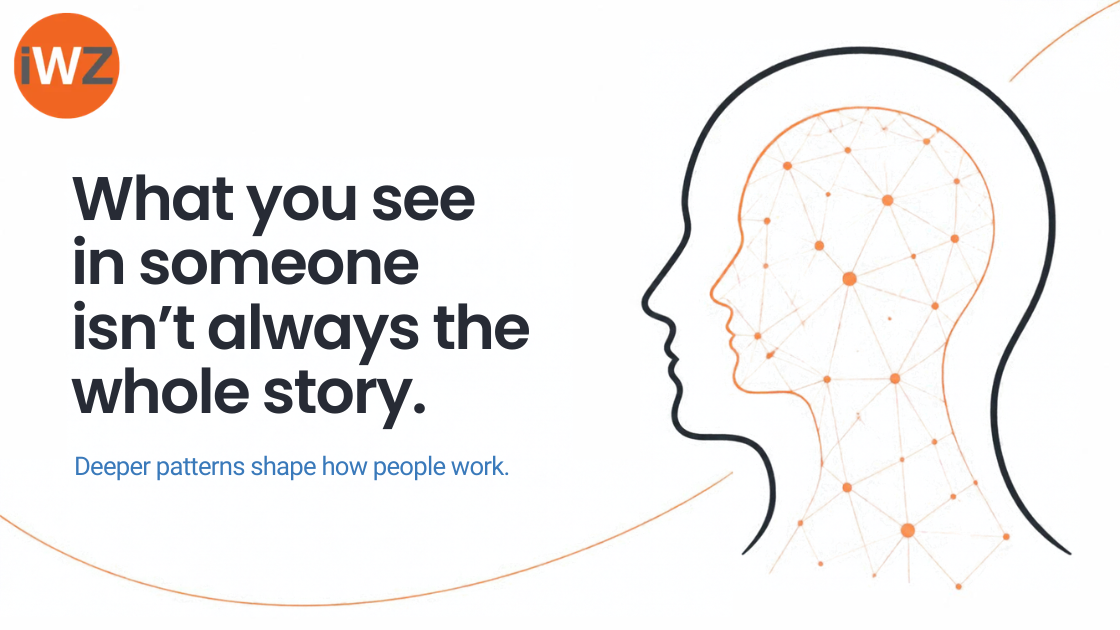
What we see in people matters.
The person who confidently takes charge in a meeting.
The employee who keeps everything organized.
The candidate who gives a great interview.
The teammate who seems to connect with everyone in the room.
Those observations tell us something.
But they don’t always tell us what is happening underneath.
And when we’re trying to understand how someone will actually approach their work, that distinction matters.
Behavior Is Valuable. It Just Isn’t the Whole Picture.
Behavior is the part of a person we see most easily.
It shows up in how someone communicates, how assertive they appear, how much structure they seem to prefer, and how they interact with the people around them.
At iWorkZone, we look at behavioral patterns such as Competitor, Coordinator, Communicator, and Cooperator. These can provide useful context around how someone is showing up today.
But behavior can also change.
People adapt to their environment. They learn from experience. They respond to different leaders, responsibilities, cultures, and expectations. A person may become more structured because their job requires it. Someone who once stayed in the background may learn to take charge. Another person may become more measured in how they communicate as their career develops.
That doesn’t make behavior unimportant.
It simply means behavior is only one part of understanding someone.
There Is Another Question Worth Asking
Instead of only asking:
What does this person look like at work?
We can also ask:
How does this person naturally approach work?
That is where Talent Wiring™ goes deeper.
Talent Wiring helps reveal the underlying patterns that influence how someone naturally processes information, solves problems, engages with people, responds to change, creates ideas, builds structure, and moves work forward.
Those patterns can explain things that behavior alone sometimes cannot.
For example, two people may both appear confident and driven.
One may naturally move quickly toward an opportunity and figure out the details along the way.
The other may appear equally decisive, but need to understand the purpose behind a decision before fully committing to it.
From the outside, both may look like strong, action-oriented people.
Underneath, they may be approaching the work very differently.
The opposite can happen too.
Two employees may look completely different behaviorally, yet share very similar underlying drivers. Jeff Yates has seen this repeatedly in team analysis: people who appear very different externally can still be wired to see work in remarkably similar ways.
That difference matters when you’re trying to lead, communicate, build teams, or understand why the same situation produces very different reactions from different people.
Think About the Person Who Keeps Asking “Why?”
A leader introduces a new process.
Most of the team seems ready to move.
One employee starts asking questions.
Why are we changing this?
What problem are we solving?
Why is this better than the current approach?
It can be easy to interpret that behavior as resistance.
Sometimes it is.
But sometimes the person simply has a strong natural need to understand the why before they can fully commit.
Within Talent Wiring, Realistic wiring is closely connected to that need for purpose and understanding. Once the reasoning makes sense, that same person may become one of the strongest supporters of the change.
That is a very different leadership problem than dealing with someone who simply refuses to change.
And you may never see the difference if you only look at surface behavior.
The Same Is True Across a Team
One person naturally sees possibilities and the big picture.
Another immediately starts thinking about how the idea will actually work.
Someone else is focused on who will be affected.
Another wants to know whether the idea makes sense in the first place.
None of those approaches is automatically better.
In fact, teams often become stronger when they contain people who naturally see work from different angles.
The challenge is that those differences can also create frustration when nobody understands what is driving them.
The big-picture thinker may wonder why someone keeps slowing the conversation down with questions.
The detail-oriented teammate may wonder why everyone is getting excited about an idea that doesn’t have a plan behind it.
The leader may assume one person lacks enthusiasm when that person simply needs more context.
Understanding Talent Wiring gives teams another way to interpret those moments.
Instead of immediately asking, “What’s wrong with this person?”
we can start asking, “What are they seeing that I may not be seeing?”
That is a much more productive conversation.
This Matters in Hiring Too
Hiring naturally puts a lot of emphasis on visible information.
The résumé.
The experience.
The interview.
How someone communicates.
How confident they appear.
How well they connect with the people in the room.
All of those things have value.
But they still describe only part of the person.
Someone can learn how to interview well. They can develop stronger communication skills. They can become more organized. They can adapt their behavior to a professional environment.
The deeper question is whether the work itself aligns with how that person naturally approaches problems, decisions, people, structure, pace, and contribution.
Talent Wiring doesn’t replace the résumé, the interview, experience, or human judgment.
It adds another perspective.
And sometimes that perspective explains what the surface information cannot.
Better Understanding Creates Better Conversations
This is ultimately why the distinction between behavior and Talent Wiring matters.
It isn’t about putting people into boxes.
It is about giving leaders, teams, and individuals more context.
Behavior helps us understand how someone is showing up.
Talent Wiring helps us better understand what may be driving the way they approach their work.
When we understand both, we can communicate differently.
We can lead differently.
We can build teams with greater intention.
We can ask better questions during hiring and development.
And we can create work environments that recognize something simple but easy to forget:
People do not all experience work the same way.
Sometimes the most valuable part of understanding someone is looking beyond what you notice first.
Talent Wiring™ helps make that possible.